The Quiet Apothecary
A Guided Materia Medica with Recipes, Resources and Herbal Wisdom
Listen to the Whispers of Herbs
A guided Materia Medica journal with space for herbal notes, recipes, and reflections—woven with sidebars of practical wisdom, instructions on many herbal preparations and plenty of resources to inspire your herbal journey.
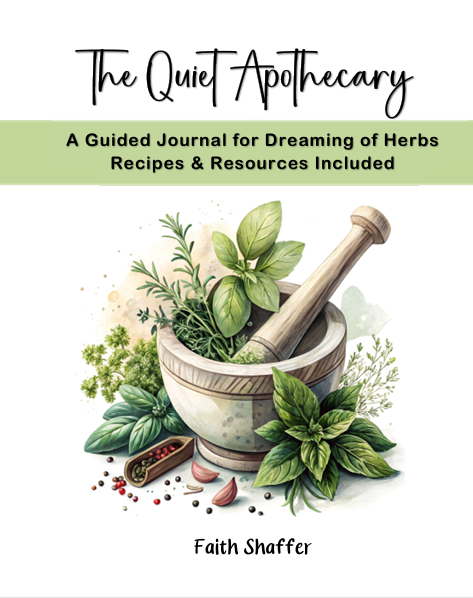
This book has yet to be published. Shown is the title page.

Links from
The Quiet Apothecary by Faith Shaffer
Sidebars ~ Foundational Herbal Glossaries ~ Some of My Favorite Sites ~ Herbal Sites ~ Gardening Sites ~ Plant Databases ~ Aromatherapy ~ Pets & Herbs ~ Apps for Herbs ~ Find Fellow Herb Lovers ~ Some of My Favorite Books ~ Invasive Plants ~ At-Risk Herbs ~ Herbal Energetics
As an Amazon Associate, I earn from qualifying purchases (at no cost to you). #CommissionsEarned
Sidebars
- A very detailed webpage on using herbs safely
- The Ethics of Foraging
- Choosing Safe Herbs for Your Kids
- Beneficial Weeds @ Wikipedia
- Weed @ Wikipedia
- Hardiness Zone Map for the US
- Hardiness Zones for outside the US
- Understanding the Comedogenic Scale for Oils and Butters
- Carrier Oils and Their Benefits
- List of Carrier Oils
- Materia Medica Fact Sheets @ Southwest School of Botanical Medicine by Michael Moore, the founder
- Herbal Capsules 101
- Preparations How-To @ The Herbal Academy
- Using Bitter Herbs for Medicinal Purposes
- Women Blazing Trails – Magnesium Lotion
- Chestnut School of Herbal Medicine – Our Favorite Herbal Books
- Goodreads – Best Herbalism Books
- Botany Culture Co. – Must Have Herbalism Books
- Patti Wigington – Magical Herbalism Recommended Reading List
- Excellent Essential Oil Supplier
- Top Essential Oil Supplier
- Top Essential Oil Supplier
- Top Essential Oil Supplier
- ASPCA List of Toxic Plants
Websites on Useful Plants
Foundational Herbal Glossaries
- Herbal Reality: Western Herbal Classifications Glossary – Traditional Western medicinal herbal terms and actions, Traditional Western treatment methods and Traditional Western herbal medicine energetics. One of my favorite herbal sites.
- Mountain Rose Herbs: Basic Herbal Terminology
Some of My Favorite Sites
- Useful Wild Plants Encyclopedia – The website calls the encyclopedia(s) “a botanical gem of the century” which is quite accurate. Anyone interested in useful wild plants NEEDS these encyclopedias. Don’t be scared of the price – they are totally worth it!
- Native Plant Trust: Go Botany – Though this site is for New England only, it has an excellent visual botanical glossary.
- Native Plant Society of Texas: Native Plant Database – While not a key-based tool, this searchable database lets you filter by region, plant type, and attributes to find native species suited to your landscape.
- ForagingTexas.com – Find detailed posts on over 200 edible and medicinal plants, including cultivated plants. Each plant is shown in multiple, big pictures, as is all the information you need for proper identification. The edible and medicinal uses are listed, as well as range maps for Texas and the United States. Many plants are found throughout the United States (and some even worldwide). The creator of the website also has a companion book (see below).
- HerbalReality.com – An excerpt from their mission statement is the best description of this website: “Our mission is to share traditional, scientific and practical insights into herbal medicine that inspire a deeper understanding of the power of plants and natural healing.” Besides this, I’m a fool for organization and love how their articles are formatted 🙂
Herbal Sites
- The Herb Society of America, Inc. – Promotes the ‘knowledge, use, and delight’ of herbs. Units are found throughout the US.
- Southwest School of Botanical Medicine – The site contains extensive lectures (free!) and PDFs on herbal history and materia medica. An enormous resource you can lose yourself in for hours if you aren’t careful 😉
- The Wealth of the Rainforest Pharmacy to the World
- Mountain Rose Herbs – A supplier with an excellent educational blog.
- The Botanical Institute – Over 80 deep plant monographs and research-backed herbal knowledge.
- The Practical Herbalist – Some content on the site is free, while other requires payment. Though there is a generous amount of valuable free material – recipes, preparation guides, and detailed herbal information.
- Herbal Academy Blog
- Earthsong Seeds – Information on all aspects of herbs – growing them, using them, preserving them with many preparations, etc.
- Plant Path Blog – The main part of the site offers paid courses, but the blog is free and has all kinds of informative articles.
- WholisticMatters.com – The Education Resources section has a podcast and an “Herbal Glossary” that includes details about many herbs, etc. Each herb lists contraindications.
- Grow Forage Cook Ferment – Should be called Grow, Forage, Cook, Ferment, Herbalism, Homestead like their menu! Guess that is a bit long though…
- The Kitchen Apothecary – Learn the techniques to be healthy using herbs, spices & local plants from a former naturopath.
- Essential Oils for Chakras: Ultimate Guide to Energy Healing
- Native American Ethnobotany: A Database of Foods, Drugs, Dyes and Fibers of Native American Peoples, Derived from Plants
Gardening Sites
- Almanac.com – Incredible! Like the print version of The Old Farmer’s Almanac, this site is chock full of helpful information on: gardening, weather, moon & sun, calendar, and food.
- Garden.org – This site is the largest social media website dedicated exclusively to gardening. There are: online tools that help gardeners connect, teach, share, and trade with each other; the world’s largest database of plants; a catalog of thousands of articles that teach people how to get started gardening and improve their plant growing skills; five free courses anyone can take; etc.
- Lady Bird Johnson Wildflower Center – This site hosts Native Plants of North America, the most comprehensive guide to North American native plants in existence, with a free and searchable database of information about more than 25,000 native plants, 80,000 plant images, answers to more than 10,000 plant and natural gardening questions and more. Their Wildflower magazine is a nationally recognized source of native plant information and inspiration for our members.
- DavesGarden.com – One of the largest gardening sites online, with over 805,000 registered members, from novice gardeners to experienced market growers. Share information, tips, plants and seeds, along with gardening triumphs and trials in this vibrant community or browse (or submit sitings to) the huge databases they have for plants, bugs, and birds.
- The Plant Native – Here you can find information on Native Plant Societies and Wild Ones groups in the United States and Canada.
- MelissaKNorris.com – Podcasts and many thorough articles on homesteading topics, including gardening
- Mother Earth News– Offers free guides, but the best content requires a low-cost subscription. Membership includes full access to the online video learning library, a year of the digital magazines (a bit more for printed), plus unlimited online articles, recipes, project ideas and more.
Plant Database Sites
- World Flora Online – The title says it all. Digging through this site, you will also find links to many more databases. Some of these are more exhaustive than others.
- Flora of North America – From their website “Flora of North America (FNA) presents for the first time, in one published reference source, information on the names, taxonomic relationships, continent-wide distributions, and morphological characteristics of all plants native and naturalized found in North America north of Mexico.” All of the encyclopedias are not complete yet, but what is online is wonderful.
- National Champion Trees – This program catalogs the biggest trees in the US
- USDA Natural Resources Conservation Service – Has detailed information, including images, and location maps with native/non-native status for each place the plant is found.
- North American Vascular Flora – BONAP provides in-depth information on the entire vascular flora of the continent north of Mexico, as well as for Hawaii and Puerto Rico. This site offers several databases with extreme amounts of information. A must-visit!
Aromatherapy
- Aroma Web – Educational: offers essential oil profiles, safety tips, blend recipes, and more.
- Aromatherapy and Essential Oil Inhalers
- Base Formula Blog – UK-based supplier and educator: Shares expert advice on wellness, skincare, and essential oil use.
- Aromatherapy essential oils for repetitive strain injury
- Aromatherapy Uses and Possible Benefits
Pets & Herbs
- Adored Beast Apothecary
- The Vet Desk: Herbs that are safe for cats
- The Vet Desk: Calendula use for cats
- Preventative Vet
- Holistic Pet Care: Soothing Dog Anxiety
- ASPCA Toxic and Non-Toxic Plants List – Are the potted herbs/plants or flower arrangements inside your home safe for your furbabies?
- Calendula and Other Herbs for Canine Skin Health – An excerpt from a book about herbs for dogs – a couple of recipes for Hot Spot Spray.
Apps for Herbs
Find Fellow Herb Lovers
- The Plant Native – Native Plant Societies and Wild Ones groups
- Tree Climbing – A tree climbing group. Unusual, but sounds fun!
- Facebook Group – Apothecary 101
- Facebook Group – Tinctures, oils and salves
- Facebook Group – Herbal Gardening for Beginner Gardeners
- Reddit Forum – Herbalism
- Reddit Forum – Essential Oils
- iNaturalist.org
- Garden.org
- DavesGarden.com
- Chestnut School of Herbal Medicine Resources
Some of My Favorite Books
Some of my favorite books explore the many uses of plants—medicinal, edible, magical. I’m especially drawn to native wild plants, which are often overlooked yet deeply useful. In this journal, I use “herbs” to mean all useful plants. Even when wild plants aren’t commonly called herbs, they truly belong in that category.
- Burrell, C. Colston. Native Alternatives to Invasive Plants (2006) – A must have! Most plant nurseries will sell you anything as long as it sells. It is up to you to make sure you take the right (environmentally-safe) plants home.
- Castleman, Michael. The Healing Herbs: The Ultimate Guide to the Curative Power of Nature’s Medicines.
- Cheatham, S., L. Johnston, and M. Marshall. The Useful Wild Plants of Texas, the Southeastern and Southwestern United States, the Southern Plains, and Northern Mexico. Vols. 1–4 – The website calls the encyclopedia(s) “a botanical gem of the century” which is quite true. Anyone interested in useful wild plants NEEDS these encyclopedias. Don’t fear the price – they are worth even more! I can’t wait until they complete the series.
- Culpeper, Nicolas. Culpeper’s Complete Herbal. [Kindle edition $.99!] – I have linked to the 2019 version, annotated by herbalist Steven Foster, that includes updated scientific names, and modern uses and cautions. The Project Gutenberg has a free scan of the old book without annotation. Since this Gutenberg version is from the 1600s, don’t try anything in it without modern verification.
- Cunningham, Scott. Cunningham’s Encyclopedia of Magical Herbs (Llewellyn’s Sourcebook Series). [Kindle] – You can’t go wrong with any of Cunningham’s books—they’re excellent.
- ———. Cunningham’s Encyclopedia of Wicca in the Kitchen. [Kindle Unlimited]
- ———. Magic in Food: Legends, Lore & Spellwork.
- ———. Magical Aromatherapy: The Power of Scent (Llewellyn’s New Age). [Kindle]
- ———. Magical Herbalism: The Secret Craft of the Wise (Llewellyn’s Practical Magick Series). [Kindle]
- ———. The Complete Book of Incense, Oils and Brews (Llewellyn’s Practical Magick Series). [Kindle]
- ———. Earth, Air, Fire & Water: More Techniques of Natural Magic (Llewellyn’s Practical Magick Series). [Kindle Unlimited] [Audiobook]
- Duke, James A., Ph.D. The Green Pharmacy: The Ultimate Compendium of Natural Remedies from the World’s Foremost Authority on Healing Herbs.
- Elias, Thomas S., and Peter A. Dykeman. Edible Wild Plants: A North American Field Guide.
- Elpel, Thomas. Botany in a Day: The Patterns Method of Plant Identification. – A must-have! Elpel’s website is Wildflowers-and-Weeds.com & BotanyEveryDay.com has a course based on this book.
- Foster, Steven and James A. Duke, Ph.D. Peterson Field Guide to Medicinal Plants & Herbs of Eastern & Central North America. – A must-have!
- Grieve, Mrs. M. A Modern Herbal (1931) – Available free online, or the 1971 version can be purchased on Amazon: Volume 1 [Kindle] and Volume 2 [Kindle].
- Harris, James G. and Harris, Melinda Wolf. Plant Identification Terminology: An Illustrated Glossary. – A must have if you are at all interested in learning more about plants. The illustrations make it very easy to follow and to remember.
- Foster, Steven and Hobbs, Christopher. A Peterson Field Guide to Western Medicinal Plants and Herbs. – A must-have!
- Hutchens, Alma R. A Handbook of Native American Herbs: The Pocket Guide to 125 Medicinal Plants and Their Uses. [Kindle]
- Lust, John. The Herb Book: The Most Complete Catalog of Herbs Ever Published. – This was the book that started my love of herbs!
- Peterson, Roger Tory. Edible Wild Plants: Eastern/Central North America (Peterson Field Guides). – A must-have!
- Thayer, Samuel. The Forager’s Harvest: A Guide to Identifying, Harvesting, and Preparing Edible Wild Plants. [Kindle]
- Tierra, Michael. The Way of Herbs. [Kindle] – A must-have!
- Tull, Delena. Edible and Useful Plants of Texas and the Southwest: A Practical Guide. [Kindle] – This was the 2nd book that I discovered on herbs. I used her recipe the first time I made prickly pear jelly–the best jelly in the world (& apparently anti-cancer!). There is another book by Tull, Edible and Useful Plants of the Southwest: Texas, New Mexico, and Arizona, which appears to be an expanded version of the original. It is available in Kindle Unlimited.
- United Plant Savers. COMPENDIUM: Journal of Medicinal Plant Conservation (2000-2019): Volume 1 & 2 – All issues & both compendiums can be downloaded FREE from the website or purchased on Amazon. An amazing resource!
- Vorderbruggen, Mark “Merriwether.” Foraging: Explore Nature’s Bounty and Turn Your Foraged Finds into Flavorful Feasts [Kindle] – Covers 70 of North America’s tastiest and easy to find wild edibles shown with the same big pictures as on his website ForagingTexas.com. A must-have!
- Wood, Matthew. The Earthwise Herbal: A Complete Guide to Old World Medicinal Plants, Volume I & Volume II. [Kindle: Volume I] [Kindle: Volume II]
Invasive Plants
- InvasivePlantAtlas.org (US)
- iucngisd.org/gisd (world; includes animals, fungi & plants)
- North American Invasive Species Network
- InvasiveSpeciesCentre.ca (prevents & manages invasive species throughout Canada)
- Invasive Species @ Wikipedia
- Eat the Invasives! @ Wikipedia
- Native Alternatives to Invasive Plants by Burrell, C. Colston. (2006) – A must have! Most plant nurseries will sell you anything as long as it sells. It is up to you to make sure you take the right (environmentally-safe) plants home.
- Tinkering with Eden: A Natural History of Exotics in America by Kim Todd (2002)
At-Risk Herbs
- UnitedPlantSavers.org – For over 30 years, they have been protecting native medicinal plants, fungi, and their habitats while ensuring renewable populations. Their “Species At-Risk” list.
- IUCNredlist.org – The world’s most comprehensive information source on the global extinction risk status of animal, fungus and plant species.
- Planting the Future: Saving Our Medicinal Herbs by Rosemary Gladstar & Pamela Hirsch [Kindle] – A collective endeavor by United Plant Savers, featuring America’s most respected and well-known herbalists.
- COMPENDIUM: Journal of Medicinal Plant Conservation (2000-2019): Volume 1 & 2 by United Plant Savers (2019) – All issues & both compendiums are available FREE from UnitedPlantSavers.org or purchased on Amazon. Amazing!
- The Forest Farmers Handbook: A Beginners Guide to Growing and Marketing At-Risk Forest Herbs by United Plant Savers – Available for FREE on UnitedPlantSavers.org or purchase on Amazon.
- The State of the World’s Trees by Botanic Gardens Conservation International
- Growing At-Risk Medicinal Herbs, Cultivation, Conservation and Ecology by Richo Cech
- Plant Conservation: Why It Matters and How It Works by Timothy Walker
Herbal Energetics
- An Introduction to Herbal Energetics @ Herbal Reality
- Western Herbal Energetics and the Four Humors System @ Clinical Herbalism
- Herbal Terminology: Herbal Actions, Categories, Energetics, Flavors, and Properties @ The Herbal Academy
- Vital Energetics: Foundations of Herbal Intelligence Course @ Clinical Herbalism
